Getting startedImporting SQL
Importing SQL
resin reads the DDL of a schema you already have and writes it as resin. Paste a CREATE TABLE script into the playground, or convert a file on the command line. The other way, from resin to DDL, is Generating SQL.
From SQL to resin
Here is a MySQL script:
CREATE TABLE users (
  id     bigint       NOT NULL AUTO_INCREMENT,
  email  varchar(255) NOT NULL,
  PRIMARY KEY (id),
  UNIQUE KEY uk_email (email)
) COMMENT='People who sign in';

CREATE TABLE orders (
  id          bigint    NOT NULL AUTO_INCREMENT,
  user_id     bigint    NOT NULL COMMENT 'Who placed it',
  coupon_id   bigint,
  status      enum('PENDING','PAID','CANCELED') NOT NULL DEFAULT 'PENDING',
  memo        text,
  created_at  datetime  NOT NULL DEFAULT CURRENT_TIMESTAMP,
  PRIMARY KEY (id),
  KEY ix_user_status (user_id, status),
  CONSTRAINT fk_orders_user FOREIGN KEY (user_id) REFERENCES users (id),
  CONSTRAINT fk_orders_coupon FOREIGN KEY (coupon_id) REFERENCES coupons (id)
) COMMENT='Customer orders';

CREATE VIEW paid_orders AS SELECT * FROM orders WHERE status = 'PAID';
resin writes it as:
%% Skipped: 1 view

external table coupons {
  id  bigint  pk
}

table users "People who sign in" {
  id     bigint        pk
  email  varchar(255)  uk as uk_email
}

table orders "Customer orders" {
  id          bigint    pk
  user_id     bigint    -> users  "Who placed it"
  coupon_id   bigint?   -> coupons
  status      enum      enum(PENDING, PAID, CANCELED)
  memo        text?
  created_at  datetime
  index(user_id, status) as ix_user_status
}
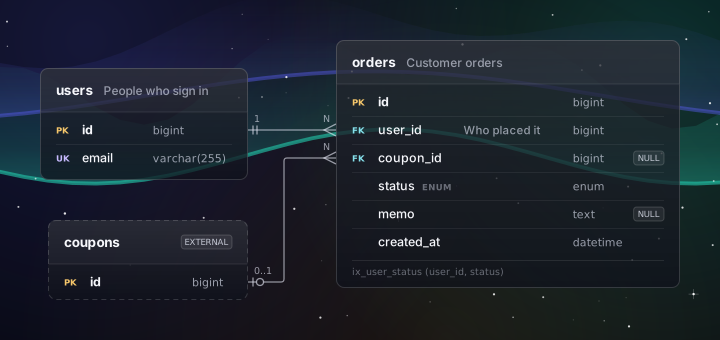
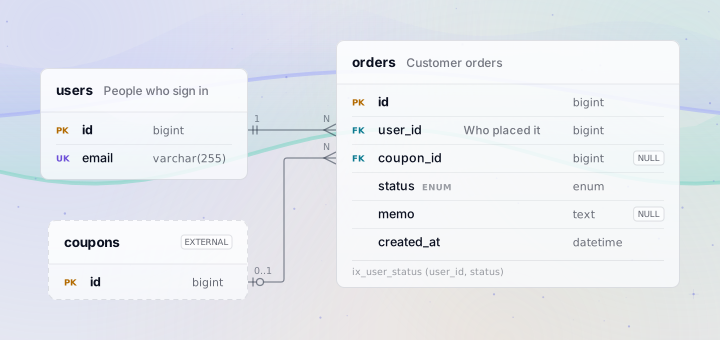
A column without NOT NULL may be empty in SQL, so it gets a ?. The keys and indexes listed under the columns move onto the columns they cover, a foreign key becomes ->, and the comments become descriptions. AUTO_INCREMENT and DEFAULT are left out: a diagram does not show them. coupons is referenced but not created here, so resin declares it as an external table with the one column the reference points at.
Where to paste it
In the playground, paste the SQL into the editor. It comes in as resin, and the line under the editor's header says how many tables were converted and takes you to the notes the conversion left. In an empty editor, or over an example you have not changed, it takes the whole document. Into a document of your own it goes where you paste it, and references to the tables already there point at them instead of adding external tables. One undo (Ctrl or Cmd + Z) brings back the SQL exactly as you pasted it.
On the command line, --from-sql prints the resin on standard output and lists what did not convert, with its line in the SQL, on standard error:
npx resin schema.sql --from-sql > schema.erd
In code, fromSql(sql) returns { source, notes, tables }. A tool that reads the schema from a live database can hand it over as data with fromSchema(schema) instead, which follows the same rules; see Library.
Dialects
There is no dialect to choose. One reader takes MySQL and MariaDB (including mysqldump files), PostgreSQL (including pg_dump plain dumps), SQLite, SQL Server (scripts with GO) and Oracle, because the ways they quote names and write comments rarely collide: names in "...", `...` or [...], comments after --, inside /* */ or, at the start of a line, after #.
Statements are read one at a time, so one that cannot be read costs only itself. Tables are collected first and everything said about them afterwards, so it does not matter whether a dump puts its keys, indexes and comments before or after the tables. A line that starts with CREATE or ALTER begins a new statement even when the one before it has no semicolon, which helps with DDL copied out of a database tool.
Unclosed quotes, comments and parentheses produce notes at their opening position. Complete statements before the broken input are still imported. Check these notes before using a partial result.
How facts carry over
| SQL | resin |
|---|---|
NOT NULL, or part of the primary key |
No ? |
| Neither | ? |
PRIMARY KEY, on the column, in the table, or added by ALTER TABLE |
pk on each of its columns |
UNIQUE on one column, UNIQUE KEY n (a), CREATE UNIQUE INDEX n ON t (a) |
uk as n on a |
| The same over several columns | unique(a, b) as n |
KEY n (a), INDEX n (a), CREATE INDEX n ON t (a) |
index as n on a |
| The same over several columns | index(a, b) as n |
REFERENCES t (c) or FOREIGN KEY (a) REFERENCES t (c), also in ALTER TABLE |
-> t when c is the primary key of t, -> t.c otherwise |
FOREIGN KEY (a, b) REFERENCES t (x, y) |
foreign(a, b) -> t(x, y), preserving both column orders and the constraint name |
| A reference to a table the SQL does not create | An external table with the columns pointed at |
MySQL enum('A', 'B') |
Type enum with enum(A, B) |
PostgreSQL CREATE TYPE s AS ENUM ('A', 'B') |
Type s with enum(A, B) |
CHECK (c IN ('A', 'B')), and the forms pg_dump and SQL Server write for it |
enum(A, B) |
COMMENT '...', COMMENT='...', COMMENT ON TABLE and COLUMN, SQL Server's MS_Description |
The description |
revinfo and <table>_aud (Hibernate Envers) |
audit envers(...) on <table> |
When the tables come from two or more schemas, each schema's tables are written in a service named after it, as a schema per service is a common way to split one database, and the diagram shows the schemas as areas. One schema, such as public alone, makes no service. A foreign key from one schema into another stays ->, as the SQL has it, so resin warns about it.
An explicit schema is respected: sales.items never points at stock.items. A reference without a schema first looks in its source table's schema, then among all tables if exactly one matches. If it is ambiguous, resin leaves the reference out and adds a comment and note. Double-quoted names keep their case, so PostgreSQL's "Users" and users stay distinct. Bare names, backtick names and bracket names are matched without regard to case.
Names are written the way the CREATE TABLE spells them. A name resin cannot write bare goes in backticks (`Order Details`). When two schemas have a table of the same name, both keep their schema (`sales.items`). Backticks and line breaks inside a name become underscores. A numeric suffix prevents collisions with another name, and the notes list every rename. References follow the renamed table or column.
Types
A type becomes one lowercase name with number arguments.
| SQL | resin |
|---|---|
character varying(20), double precision |
varchar(20), double |
timestamp with time zone, timestamp without time zone |
timestamptz, timestamp |
serial, bigserial |
integer, bigint |
int(11), bigint(20) unsigned |
int, bigint: display widths and unsigned do not change the type |
text[] |
_text, PostgreSQL's own name for the array type |
nvarchar(max), varchar2(30 byte) |
nvarchar, varchar2(30) |
public.order_status |
order_status |
| A SQLite column with no type | any |
What is left out
Some of what DDL says never shows in a diagram, and is dropped: defaults, AUTO_INCREMENT and identity, checks other than value lists, ON DELETE and ON UPDATE, collations, storage and partition options, sequences, privileges and data. Views, triggers, functions and procedures are not drawn either; a comment at the top counts them.
What a diagram would show but resin cannot write yet stays in its table as a %% comment, and is listed among the notes:
table order_items {
  order_id  bigint   pk  -> orders
  line      integer  pk
  shop_id   bigint?
  sku       text?
  %% Not converted: reference shop_id -> shops.code, shops has no column code
}

table orders {
  id  bigint  pk
}
That covers references whose targets cannot be resolved, indexes on expressions (lower(email)), and partial unique indexes (WHERE deleted_at IS NULL), which are drawn as plain indexes: they are unique only among some rows. Foreign keys over several columns become one foreign(...) relation with ordered column pairs. Enum values that are empty or contain a backtick or line break cannot be written; the notes list every value left out.
Logical references
Many schemas keep references only in the application, with no FOREIGN KEY behind them. --infer-refs on the command line, or inferReferences: true in code, reads them from column names and writes them as logical references (~>).
A column called <name>_id or <name>Id that has no foreign key points at the table named after it, singular or plural, when that table has a one-column primary key of the same type: user_id points at users, categoryId at categories. A word or two in front are taken as a role, so buyer_user_id points at users too. If several tables match the name, the reference is not inferred and a note explains why. The output says on its first line that the references were inferred. Names are only a guess, so this is off unless you ask for it.