LanguageColumns and types
Columns and types
A column is written as in SQL DDL: its name first, then its type, then what is true about it, in any order.
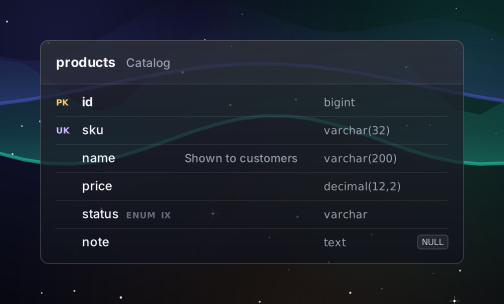
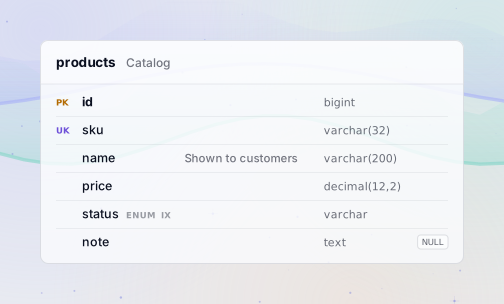
table products "Catalog" {
  id      bigint         pk
  sku     varchar(32)    uk as uk_products_sku
  name    varchar(200)   "Shown to customers"
  price   decimal(12,2)
  status  varchar        enum(ACTIVE, HIDDEN)  index
  note    text?
}
Types
The type is the physical type name, with its arguments when it has them: bigint, varchar(32), decimal(12,2). resin keeps it as written and does not check it against a database, and the arguments may be left out.
A ? right after the type makes the column nullable; see Nullability.
Modifiers
| Modifier | Meaning |
|---|---|
pk |
Primary key; see Keys |
uk, uk as name |
Unique |
index, index as name |
An index that starts at this column; see Indexes |
enum(A, B) |
The values the column may hold; see Enums and encryption |
enc |
Stored encrypted |
-> table.column |
Foreign key; see References |
~> table.column |
Logical reference |
"..." |
A description for people |
Writing the same modifier twice on one column is an error.
Descriptions carry no facts
A description is for people. Anything a modifier can say goes in a modifier: write index, not "indexed", and ~> users, not "refers to users". Facts written as syntax are checked and drawn; facts written in a description are not.