LanguageReferences
References
A reference is written on the column that holds it. -> is a foreign key the database enforces; ~> is a reference only the application keeps. resin draws both from that column to the column they point at, and works out how many rows sit on each side.
Foreign and logical
external table users "Accounts service" {
  id  bigint  pk
}

table orders "Customer orders" {
  id       bigint  pk
  user_id  bigint  ~> users  "Customer"
}

table order_items "Order lines" {
  id        bigint  pk
  order_id  bigint  -> orders.id
}
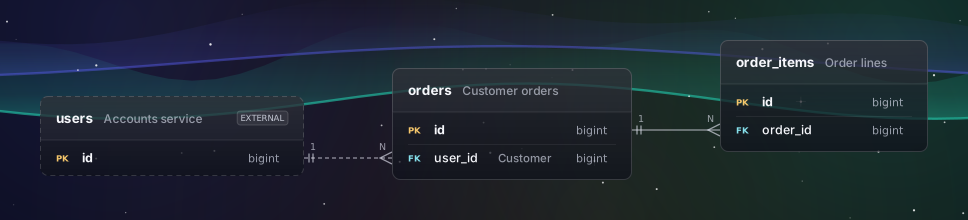
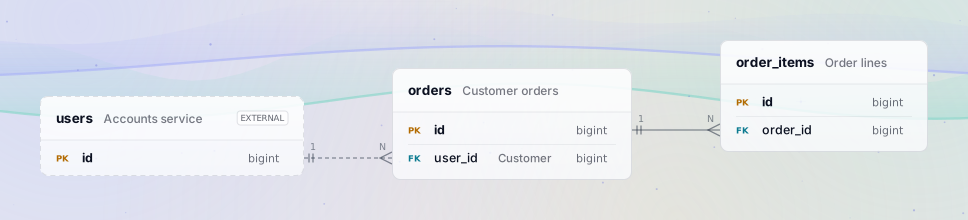
order_items.order_id has a FOREIGN KEY constraint in the database, so it uses -> and is drawn solid. orders.user_id points into another service, where no constraint can exist, so it uses ~> and is drawn dashed. A table owned by someone else is declared external: list only the columns you point at.
| Arrow | Meaning | Drawn as |
|---|---|---|
-> |
Foreign key: the database declares the constraint | A solid line |
~> |
Logical reference: the application keeps it, the database does not | A dashed line |
Which column
-> orders.id names the target column. Leave the column out and the reference points at the target's primary key, which must then be a single column. The target must be a table or an external table in the same document.
If the column types differ, say bigint against int, resin warns you. Lengths such as varchar(32) are not compared, because foreign keys often mix them.
One or many
table orders {
  id  bigint  pk
}

table payments "Payments" {
  id        bigint  pk
  order_id  bigint  uk  -> orders  "One payment per order"
}
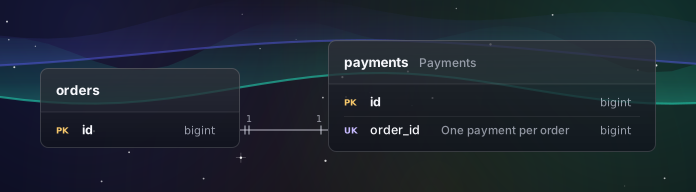
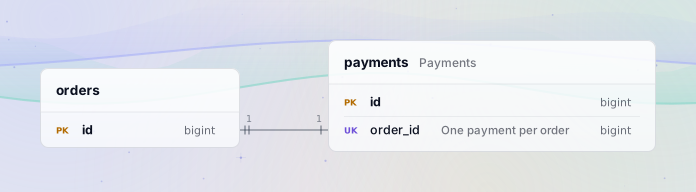
A reference is one-to-many unless the referencing column is unique. When it has uk, or is its table's only primary key, each parent has at most one child, and the relation is one-to-one. In the diagram the referencing end has a crow's foot and N, or a bar and 1.
Must a parent exist?
table users {
  id  bigint  pk
}

table payments {
  id        bigint   pk
  payer_id  bigint?  ~> users  "Empty for guest checkout"
}
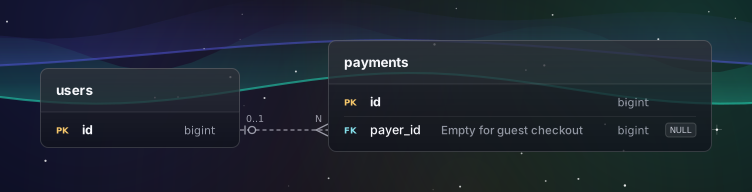
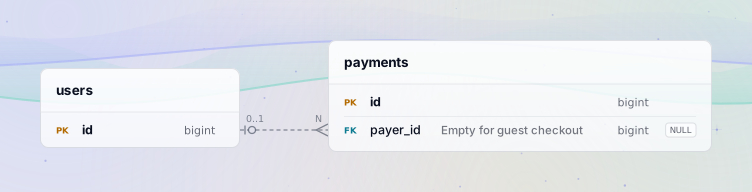
A NOT NULL referencing column means every row has exactly one parent. Make it nullable with ? and the parent becomes optional: zero or one. The diagram shows NULL on that row, and the connector's referenced end has a bar, a ring and 0..1 where a NOT NULL reference has two bars and 1.
Composite references
table products {
  tenant_id  bigint  pk
  id         bigint  pk
}

table order_items {
  id          bigint  pk
  tenant_id   bigint
  product_id  bigint
  foreign(tenant_id, product_id) -> products(tenant_id, id) as fk_product
  index(tenant_id, product_id)
}
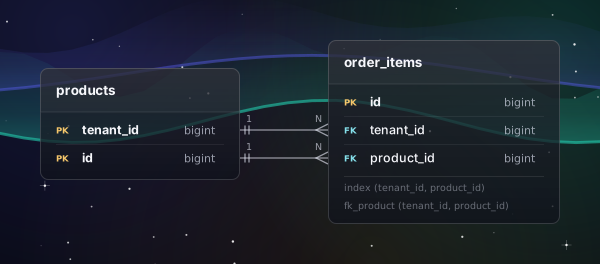
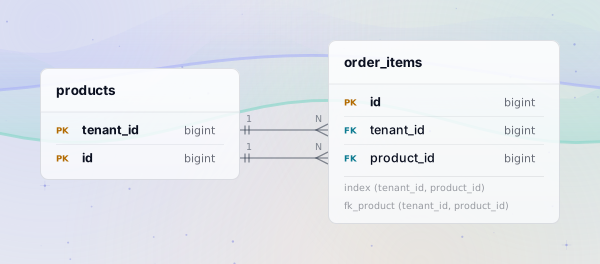
The two lists are ordered: tenant_id references tenant_id, and product_id references id. This is one constraint and one model relation. Both lists need at least two distinct columns and the same number of columns. ~> writes a composite logical reference. A target in another service uses foreign(a, b) ~> service.target(x, y).
The diagram draws each column pair. Selecting any member highlights every pair in the constraint. The details panel lists the constraint as one reference. A composite relation is one-to-one when its complete source set is a primary or unique key. It is optional when any source column is nullable.