LanguageServices
Services
resin is written for schemas split across services. A service owns its tables and keeps them in a database of its own, so a reference from one service into another cannot be a foreign key. service says which tables each service owns, the diagram draws it as an area around them, and resin warns when a -> crosses from one service into another.
service accounts "Accounts service" {
  external table users {
    id  bigint  pk
  }
}

service ordering "Order service" {
  table orders {
    id       bigint  pk
    user_id  bigint  ~> users  index
  }

  table order_items {
    id        bigint  pk
    order_id  bigint  -> orders  index
  }
}

table shipments {
  id        bigint  pk
  order_id  bigint  ~> orders  index
}
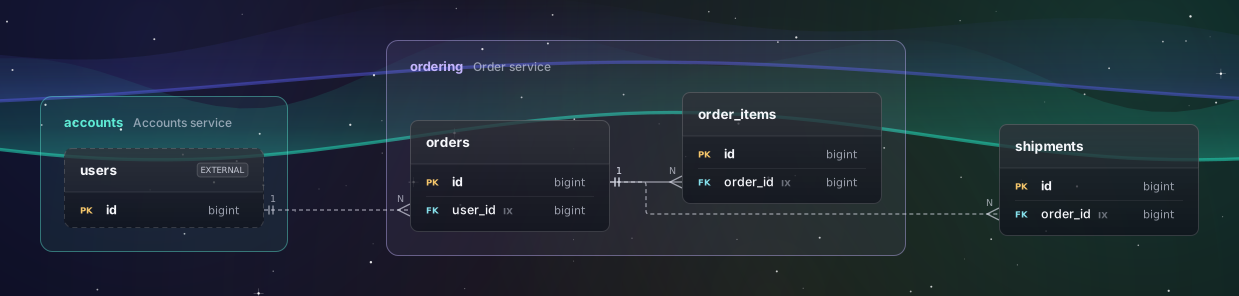
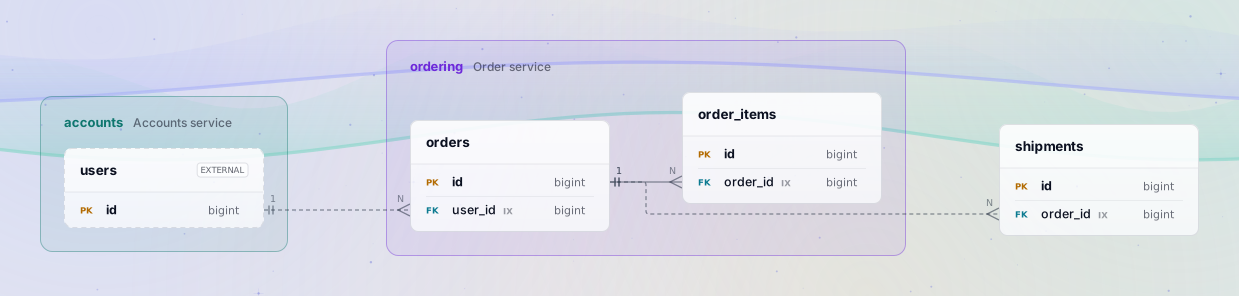
Writing a service
service name "description" { ... } holds table and external table blocks, and nothing else. The description, in double quotes, is for people and may be left out. Tables written inside a service belong to it; tables outside every service belong to none, as in a document about a single service.
Write the tables of each service the document describes in that service's block. An external table is a table of a service the document does not describe: put it in a block named after that service, and the diagram shows where the boundary runs.
References between services
Inside a service, a reference is whatever the database has: -> for a foreign key, ~> for a reference the application keeps. Between services there is no database constraint to write, so a reference is ~>. A -> from a table of one service to a table of another is reported as a warning. In orders.erd:
service accounts {
  table users {
    id  bigint  pk
  }
}

service ordering {
  table orders {
    id       bigint  pk
    user_id  bigint  -> users  index
  }
}
orders.erd:10:22: warning: foreign key `orders.user_id` crosses from service `ordering` into `accounts`
   |
10 |     user_id  bigint  -> users  index
   |                      ^^
   = hint: a FOREIGN KEY ties the data of two services together; write `~>` for a logical reference
A reference to or from a table outside every service is not checked.
Rules
- Services do not nest, and a table belongs to at most one service.
- Service names are unique within a document. A service may share its name with a table.
- Table names are unique within their service. Unscoped tables have their own namespace.
- An unqualified reference first looks in its own service, then accepts a unique matching table elsewhere. If more than one table matches, use
service.table.column. - A service with no tables is reported as a warning.
- When audit tables are drawn,
<table>_audsits in the service of its table, andrevinfoin none.
In the diagram
Each service is an area with a faint tint, an even edge and its name and description at the top left. The tables of a service are laid out together, and connectors run between services as they do inside one. In the glass looks services take hues in the order they are declared (teal, violet, amber, rose, sky, lime); the plain graphite look draws them in ink.
To see how the services depend on each other, fold them: resin --services, or Services in the playground's view options, draws each service as one card with a row per table, in the service's hue. References inside a service are counted under its card; a reference that leaves the service runs from the row of its table to the row of the table it points at (with --down, between the cards). See SVG.
In the playground, a service's name, on its area or its folded card, opens a side panel with what the service owns, what it depends on and what uses it. Service only, in that panel, draws the service's tables with the services they link to folded around them. A table's panel says which service the table is in, with a link to the service.
When resin imports SQL whose tables come from two or more schemas, it writes each schema's tables in a service named after the schema.
Same table name in different services
service accounts {
  table users {
    id  bigint  pk
  }
}

service billing {
  table users {
    id  bigint  pk
  }

  table invoices {
    id          bigint  pk
    owner_id    bigint  -> users
    account_id  bigint  ~> accounts.users.id
  }
}
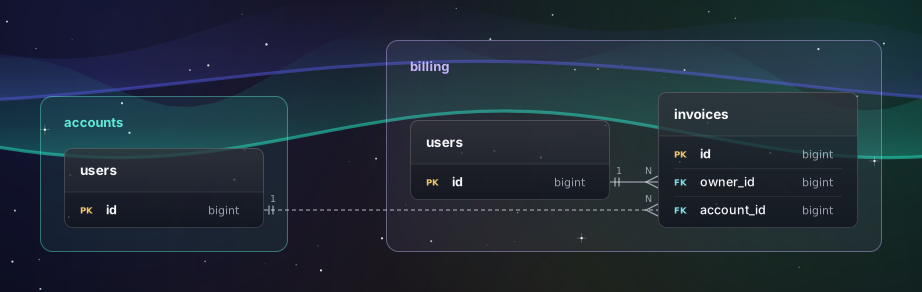
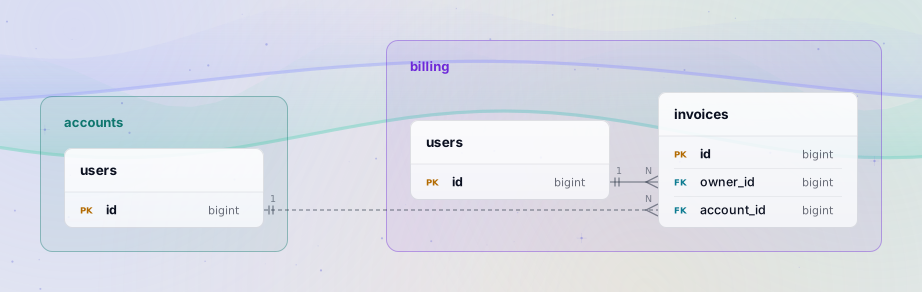
owner_id resolves to billing.users. account_id explicitly selects accounts.users. Model and diagram data identifiers use qualified names; the card title remains users. A quoted literal name such as a.b remains distinct from table b in service a.