LanguageKeys
Keys
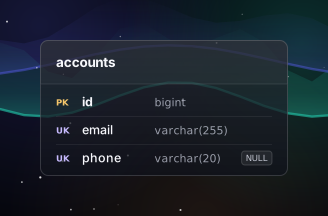
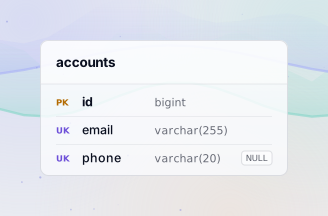
pk marks the primary key, and uk a unique column.
table accounts {
  id     bigint        pk
  email  varchar(255)  uk as uk_accounts_email
  phone  varchar(20)?  uk
}
Primary keys
Write pk on the primary key's column. Write it on several columns for a composite primary key:
table students {
  id  bigint  pk
}

table courses {
  id  bigint  pk
}

table enrollments {
  student_id   bigint    pk  -> students
  course_id    bigint    pk  -> courses  index
  enrolled_at  datetime
}
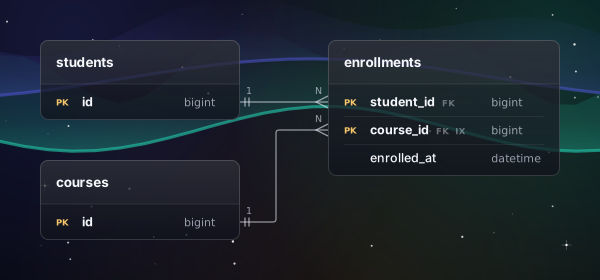
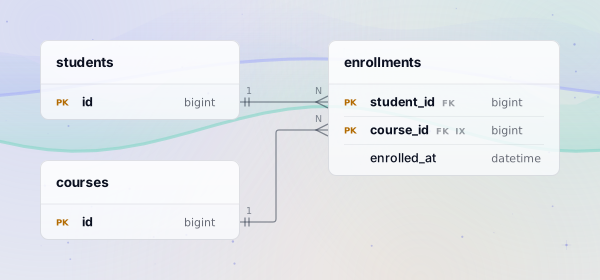
The primary key's index starts with student_id, so it serves lookups by student; course_id gets an index of its own, or finding a course's enrollments would read the whole table. Lint reports a reference column that no index starts with.
A primary key cannot be nullable. A reference that leaves out the target column points at the primary key, so that table needs a single-column one.
Unique columns
uk makes one column unique. Name the constraint with as, as in uk as uk_accounts_email. For a uniqueness that spans several columns, use the table constraint unique(a, b).
A unique column that references another table makes the relation one-to-one; see One or many.
In the diagram
Keys sit in a gutter before the column name: PK, UK, and FK for a reference. In the playground's side panel, a column with only an index shows IX there.